
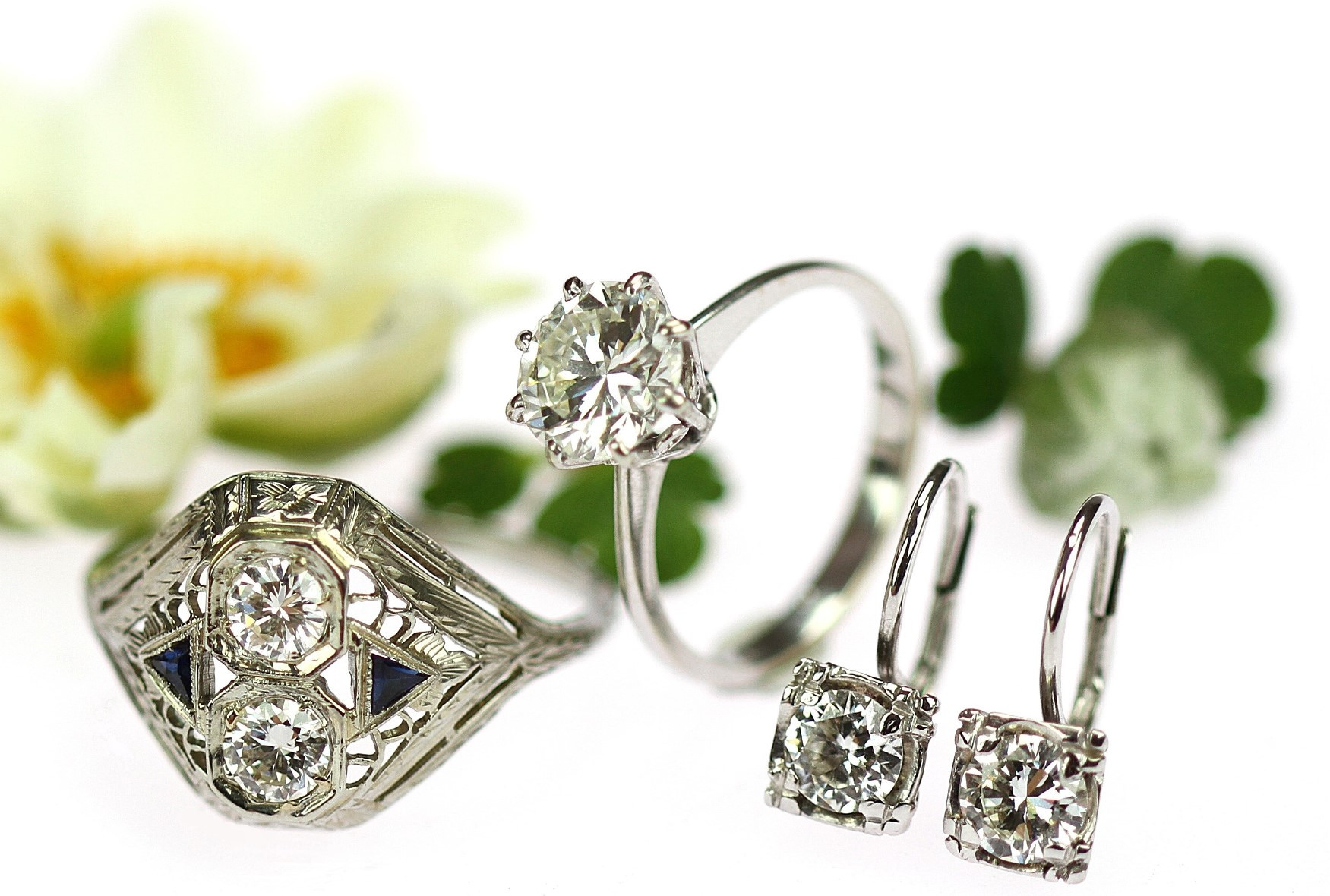
Diamonds the tears of gods - article for ART AND ANTIQUES magazine
Author: Martin Cinolter for Art and Antiques Magazine
A diamond jewel is a phenomenon for which people have been, and still are, willing to do anything. It adorns the crowns of monarchs. Many women have succumbed to the words "Will you marry me?" at the sparkle of a carat diamond.
History
The first mentions of jewellery date back 7,500–10,000 years, when people in the regions of modern-day Burma and India adorned not only themselves but also weapons with various precious stones. Diamonds began to be mined around 1,000 years BC. In India, diamonds were found in almost all colours and were long considered an accessory exclusive to men. The colour of the stone symbolised caste affiliation. Unlike today, Indians valued internal inclusions in diamonds, believing them to be spirits trapped in the stone that empowered the owner. The ancient Greeks thought diamonds were tears of the gods fallen to Earth. Diamond jewellery from India eventually spread across the globe.
Initially, diamonds were only polished. Later, Indians discovered faceting and continuously refined their cutting techniques. The first cuts followed the natural octahedral shape of raw diamonds. Over centuries, diamond cutting evolved significantly in Europe, where cutters started halving octahedrons and polishing the resulting pyramids into gemstones. A significant breakthrough in cutting came in Paris, where the first "brilliant cut" was developed, notable for its exceptional sparkle and play of rainbow colours.
Until the 18th century, all diamonds were sourced from the Ganges River's true tributaries, the Són and Kén rivers, in India. After the discovery of the Americas, diamond sources emerged elsewhere. Brazil, for instance, experienced a diamond rush over secondary deposits. The famous Varga diamond (1342.32 grams), discovered in 1936, comes from such a deposit. In South Africa, diamonds were found in 1876, and a few years later, primary deposits were located in volcanic pipes filled with blue diamond-bearing rock. Since then, South African diamond mines have supplied Antwerp and other cutters worldwide. These mines also produced the Cullinan diamond (3,025.75 carats) and the Excelsior diamond (971.50 carats).
The most famous diamond in the world, Koh-i-Noor (translated as "Mountain of Light"), was found in India near Golconda. Believed to date from the 14th century, it was held by the Malwar royal dynasty before being set in the peacock throne's eye by the Mughals. When India became part of the British Empire, it was gifted to the Queen of England, who had it recut for extra brilliance. The Orlov diamond, also from Golconda and found in 1860, was gifted by Russian Prince G. Orlov to Empress Catherine II, who had it set in a necklace and was frequently depicted wearing it. On 28 August 2007, global news reported the discovery of a grapefruit-sized diamond weighing around 7,000 carats (1.4 kg) in South Africa, surpassing the Cullinan diamond found in 1905. The Cullinan, discovered by Premier mine manager Mr. Wells, was gifted to Edward VII by the Transvaal government. It was cut into 105 brilliants at an Amsterdam workshop. The largest, Cullinan I, is set in the British royal sceptre, while the second-largest adorns the royal crown.
Regarded as the most beautiful diamond by cut, the Regent Yellow (Pitt the Millionaire) weighs 140.50 carats. The largest coloured diamond is the blue Hope diamond, originating in India and infamous for allegedly bringing bad luck to its owners.
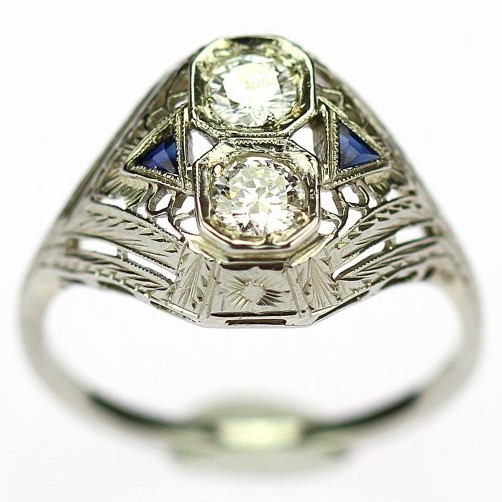
Diamonds, or brilliants, are often complemented in jewellery by other gemstones such as sapphires, rubies, and emeralds, or even pearls. However, an error often made is assuming all coloured stones in antique jewellery are natural. Mr. Verneuil developed synthetic gemstone synthesis in 1868, and this practice became widespread by 1872–73. Thus, most late 19th and early 20th-century jewellery features synthetic coloured stones, mainly spinels. While this does not detract from their beauty, it is important to remember synthetic stones possess the same physical properties as their natural counterparts.
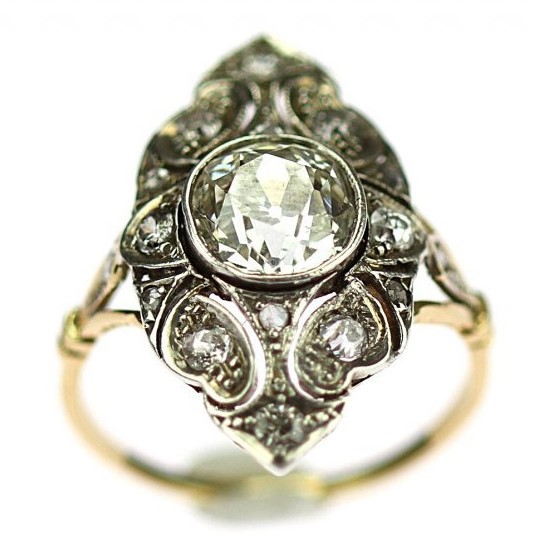
Diamonds are typically set in gold or platinum. During the Art Deco period, platinum was the preferred material. Occasionally, diamonds are set in silver, though this is rare.
It is important to note that many people mistake diamonds and brilliants as different stones. To clarify, a brilliant is a diamond, specifically a type of cut. Examples of other cuts include princess cut, Asscher cut, baguette, trapezoidal cut, etc. A brilliant cut features 57 facets, including the girdle and sometimes the culet (the small facet at the bottom of the diamond).

Buying Jewellery
Anyone considering purchasing a diamond jewel, whether as a gift or investment, should be aware of certain pitfalls. When buying a diamond jewel, it is essential to evaluate not only the carat weight (often mistaken for size) but also the colour, clarity, proportions, and cut. These five factors determine the stone's value.
One major risk for customers is moissanite, which has a hardness of 9.5, is lighter than diamond, and is difficult to distinguish even for experienced gemologists.
Another issue is the sale of replica Art Deco jewellery, which is often marketed through auction houses and antique shops. These are sometimes labelled as "Art Deco jewellery with modern brilliant cuts." Unsuspecting buyers may pay original prices for replicas. Unlike authentic pieces, these replicas are typically cast in moulds, rarely match the craftsmanship of the originals, and are set with lower-quality brilliants to keep costs down. Less problematic are old rings with synthetic stones replaced by modern brilliants. However, such pieces are still not originals, unlike restored jewellery. I believe antique shops selling replicas should inform customers of this fact.
Older cuts can often be identified, even by amateurs. Diamonds cut before 1937 generally feature higher crowns and smaller tables (the topmost facet of a diamond).
Modern cuts tend to have flatter crowns and larger tables. When well-proportioned and of good colour, these stones are noted for their brilliance.
If considering a high-value purchase, it is best to consult an expert or request a quality appraisal. Appraisals can be verified by reputable specialists.
The purchase of a brilliant-cut diamond jewel can be not only a beautiful gift for our loved ones but also a smart investment. History has proven this many times. When bought at a good price, the jewel can often be sold later at a higher value without any issues.
At a time when the Czech koruna is steadily strengthening against the dollar and euro, investment in diamonds—or diamond jewellery—is becoming an increasingly advantageous option.
Expensive jewellery often has the value of a new car or even a property. It represents the highest concentration of value in the smallest size.
However, it is also possible to purchase modest diamond jewellery of high quality in lower price ranges—perhaps comparable to the cost of a large family grocery shopping trip for a weekend at a popular supermarket.
Diamond jewellery has been accompanied for centuries by legends and fascinating intertwined fates, making it undoubtedly the king of jewels. It represents not only a piece of history but also enduring value that transcends ages.
Martin Cinolter
