
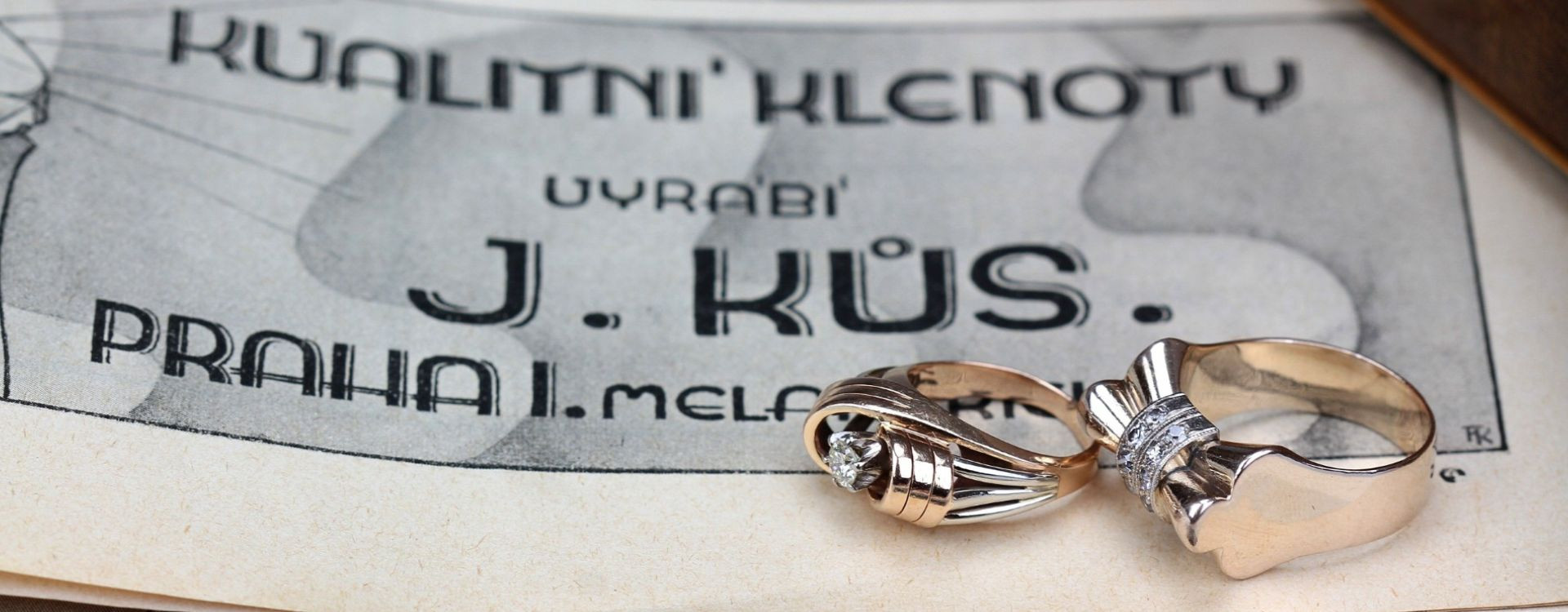
Jaroslav Kůs – A Leading Figure of Czechoslovak Jewellery
Author: Veronika Kulíková, Mgr. Ivona Vesecká
According to the testimony of his contemporaries, he was a creative, talented and hardworking man who spent two full decades at the very forefront of Czechoslovak goldsmithing. This year marks 135 years since the birth of Jaroslav Kůs, chairman of two major professional associations and the creator of the name of the Soluna cooperative.
The Kůs couple did not particularly favour jewellery-making as a profession and did not consider it a proper craft. Industrious traders from the Šumava region likely envisaged a completely different career for their son, yet young Jaroslav nevertheless trained as a goldsmith in Austro-Hungarian Vienna. Perhaps due to his parents’ lack of enthusiasm, he lived in very modest conditions during his studies; after completing his apprenticeship, however, he gradually worked his way up to founding his own company. Exactly six months after his 35th birthday, and on the 7th anniversary of the end of the First World War, on 11 November 1925, a trade licence was issued for the Kůs and Stein goldsmith’s workshop, whose premises were located at Melantrichova Street No. 5 in Prague. Due to his Jewish origin, Kůs’s business partner was forced to leave the company in 1938, after which it was run solely by the family.
Jaroslav Kůs became a prominent figure in goldsmithing circles as early as the 1920s, when he closely followed global trends, according to which jewellery was subsequently created in his workshop. Modern works produced by Kůs’s firm later became a model for many other Czechoslovak goldsmith workshops. Beyond the craft itself, Kůs’s organisational and educational activities were of crucial importance. From 1929, he served as chairman of the Association of Graduates of the State Vocational School in Turnov, which was established on his initiative. The purpose of the organisation was to provide professional oversight of education, ensuring it kept pace with global trends and trained qualified specialists in jewellery-making.
.jpg)
In the pre-war period, he also became chairman of the Union of Goldsmiths, Silversmiths and Jewellers, which, as a result of political developments in 1947, was transformed into the Soluna cooperative. The author of this name was Jaroslav Kůs himself. He cleverly combined the Latin words for the sun and the moon—symbols of gold and silver respectively—“sol” and “luna”. Soluna prevailed over competing proposals such as Aurex and Zlatana as the name of the newly established cooperative.
No less significant was his effort to establish the journal Československý zlatník (The Czechoslovak Goldsmith). As he himself wrote, this periodical was intended to serve all branches of the craft:
“We are achieving a goal that was set long ago. We are fulfilling a task whose completion was demanded by the programmes of all former corporations of the pre-Munich era. Thanks to diligent work, conscious commitment, understanding and love for the goldsmith’s craft, we have not only succeeded in organisationally uniting into a single independent whole, but we can now, through our journal, develop work and activity in such a way that we may draw closer to the times when Czech goldsmiths enjoyed a worldwide reputation…… We shall use our journal to pave the way for our products and creations abroad, to serve as a showcase of the beauty we are capable of creating and what we wish to present to the world…”
(KŮS Jaroslav: Introduction. Československý zlatník, Vol. 1 (1945), No. 1, p. 1.)

After the Second World War, Jaroslav Kůs continued his business activities. His two children were also involved in the company: his son Jaroslav served as the statutory representative but worked primarily as a jeweller, while his daughter Věra was the company’s accountant. Sadly, Kůs was twice widowed during his lifetime; his third wife was Heda Janoušková, the mother of the future actress Aťka Janoušková. She later liked to say that “overnight, she gained two wonderful siblings”.
As part of his lifelong efforts to develop the goldsmith’s craft, and especially its post-war revival, Kůs also took part in organising trade fairs and exhibitions. Of particular importance to the goldsmithing community was the second post-war Prague trade fair, held in March 1947. Among the smaller exhibitions, the goldsmiths’ display was the only one visited by President Edvard Beneš and his wife Hana.
.jpg)
The direction taken by Czechoslovakia in the second half of the 1940s was unfavourable not only to private enterprise but also to the craft to which Jaroslav Kůs had devoted his entire life. He disagreed with measures that negatively affected the system of professional goldsmith education and spoke out strongly against them. The regime also demanded that he support the government of Klement Gottwald from his position, which he categorically refused.
Jaroslav Kůs, who in addition to leading his successful company made a major contribution to unifying the goldsmith’s craft and raising its professional standards, died suddenly in the street on 6 July 1948. His business was formally transferred to his son Jaroslav, but as early as 1951 the company was removed from the register, like thousands of others, on the grounds of the “termination of trade authorisation”.
When Jaroslav Kůs senior died, the entire goldsmithing community mourned him. Numerous condolence and commemorative notices appeared in newspapers, bearing witness to the deep respect and esteem he had earned among those connected with the craft—and to the great personality that had departed forever.
