Eternal and Beautiful Diamonds
Author: Martina Exnerová
It’s well-known that diamonds are a woman’s best friend. They symbolise beauty and purity, as well as wealth, eternal love, strength, and power. Today, let's take a look at some of the most beautiful diamonds in the world.
India – the Home of Diamonds
Mining of diamonds and trade dates back to ancient times. The Roman scholar Pliny the Elder described diamonds in his encyclopaedia *Naturalis Historia* (79 AD), noting those that were washed from river gravel in India. Even older mentions of Indian diamonds blend with mythology. From antiquity, India was the only place where diamonds were mined, until the discovery of diamonds in Brazil in 1726.
From the 18th century, India gradually lost its position in diamond mining, but diamond processing and trade remain thriving industries. This is evident in the so-called Golconda diamonds – Indian diamonds mined in the area known as the "Golconda Sultanate." The famous Kollur mine in Andhra Pradesh was prominent, though the area had many mines, and historians estimate that during the 16th–17th centuries, up to 100,000 people were involved in diamond processing and trade.
Extracted diamonds were transported to Hyderabad, where they were cut, polished, and sold. This city remained a centre of diamond trade until the late 19th century. The Golconda region produced some of the world’s most famous diamonds, which continue to amaze us with their size, beauty, uniqueness, and often dramatic histories. Let’s briefly look at a few of them.
Koh-i-Noor in the British Crown Jewels
The most famous is perhaps the Koh-i-Noor – a colourless (D) diamond adorning the British Crown Jewels, which can be seen at the Jewel House in the Tower of London. This gem, brought to Britain from Punjab in 1849, was recut in 1851 by Prince Albert, Queen Victoria’s husband, to enhance its appeal. It is only worn by female members of the royal family, due to its known history of bringing misfortune to male wearers in the past. Since 1937, the diamond has been set in the front cross of the Queen Mother's Crown.
The Pink Marvel Daria-i-Noor
Another remarkable stone is the Daria-i-Noor – a beautiful light pink diamond adorning the crown jewels of the Shahs of Iran. In 1965, a Canadian expert team examining these jewels suggested that this diamond might originally have been part of a single large gem alongside the light pink Noor-ul-Ain diamond, which forms the centrepiece of an Iranian diadem. These jewels are now housed in Tehran’s Central Bank of Iran and are still considered so valuable that they back the Iranian currency.
Hope – the Blue Wonder
We also have the fascinating blue diamond Hope (Fancy Dark Greyish Blue, as per GIA), which is displayed at the Smithsonian Institution in Washington, DC. The famed New York jeweller Harry Winston donated it to the institution in 1958. The diamond journeyed from the Golconda region to Europe, thanks to the French traveller and gem dealer Jean-Baptiste Tavernier, who bought it between 1640–1667 and sold it to King Louis XIV of France around 1668–1669. The diamond, which changed owners and was renamed "Hope" over the years, holds a rich history and many legends, enough to fill a book or inspire a movie.
Orlov – Look for a Woman behind everything
Also noteworthy is the colourless Orlov diamond, which adorns the imperial sceptre of the Russian tsars. Empress Catherine the Great commissioned the sceptre, along with other crown jewels, in 1774. Orlov is unique among historic diamonds, retaining its original Indian rose cut. It is generally described as white with a faint bluish-green tint. According to the Kremlin’s records, it measures 32 × 35 × 21 mm and weighs 189.62 carats. The sceptre and diamond are currently housed in the Diamond Fund at the Kremlin Armoury in Moscow.
As a “side note,” it’s said that Count Orlov’s gift story isn’t quite true. Historians have shown that Catherine actually bought the diamond herself, with Orlov only helping negotiate the deal and arranging transport from Amsterdam. She likely created the gift story to avoid criticism for spending state funds on jewellery, as the price of 1.4 million florins was vast – only the empress herself could afford it, while Orlov’s fortune was insufficient. It’s also known that the gemstone was bought in instalments over seven years, with Catherine covering the first payment herself.
Dresden Green – the Diamond with Fortune
Lastly, we highlight the fascinating green diamond Dresden Green, which is nearest for viewing, as the name suggests. It likely originates from the Kollur mine and owes its rare green colour to natural radioactive exposure. The diamond’s recorded history dates to 1722, mentioned by the London Gazette. In 1742, it was purchased at the Leipzig Fair by Augustus III, King of Poland and Elector of Saxony. In 1768, it was set into an extraordinary piece of jewellery. In November 2019, during a major theft of jewels in Dresden’s Grünes Gewölbe where it is usually displayed, the Dresden Green was spared as it had been lent to the Metropolitan Museum of Art in New York. Thus, it was not stolen, so we can still admire this unique green gem in the future.
You Can Have Your Own Diamond
If a trip to Dresden, London, Washington, or Moscow isn’t in your plans, you can visit our shop, whether our physical location at our permanent address or our website, and choose your unique, perfect diamond – whether a loose stone or set in beautiful jewellery of exceptional historical value.
Related products
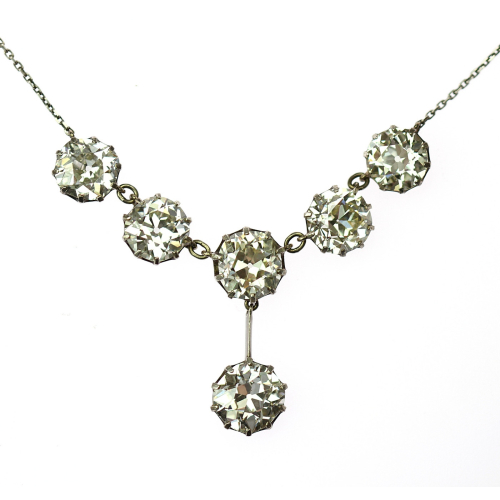
SOLD - Diamond necklace 24,2ct

SOLD - Diamond necklace - 50 ct