
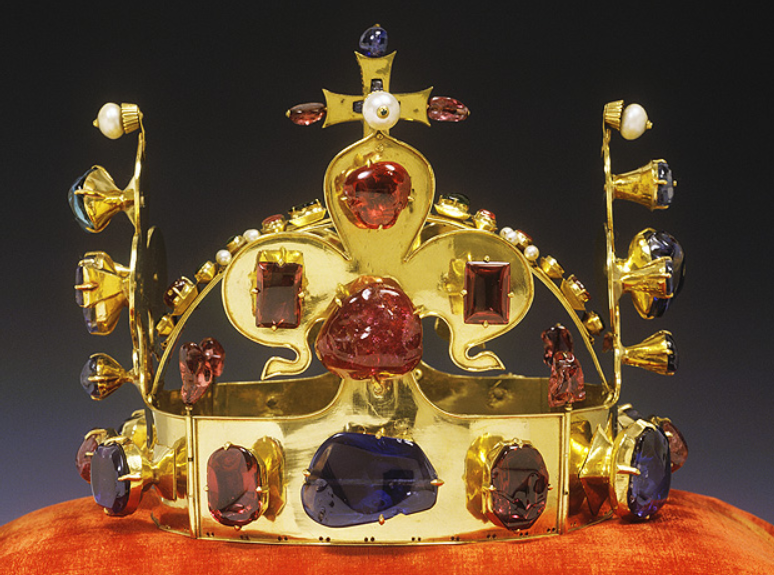
St. Wenceslas Crown
Author: Martina Exnerová
Today is 28 September, a public holiday in the Czech Republic, and the day when we commemorate St. Wenceslas, the protector of the lands of the Czech Crown. Let us take a closer look at the precious stones that adorn the St. Wenceslas Crown, the most precious and famous piece in the remarkable collection of Czech coronation jewels.
The crown was commissioned by Charles IV, King of Bohemia and Holy Roman Emperor. In his person, the power, traditions, and holdings of the ancient Přemysl dynasty combined with the ambition and excellent diplomatic skills of the Luxembourg dynasty. Charles ordered the crown to be made during his father John of Luxembourg's lifetime and was also the first to be crowned with it on 2 September 1347. The crown, however, is not the personal property of the monarch or his family; rather, it belongs to St. Wenceslas, the Přemysl prince and patron of the Czech Kingdom. St. Wenceslas symbolically lends the crown to monarchs for the duration of their reign. The Czech coronation jewels are protected by numerous measures and regulations, originating from Charles IV himself and even a papal bull by Pope Clement VI from 1346. The development of the so-called protective legend is also interesting, perhaps more modern, and was fully established during the Second World War.
That’s the introduction, and now let’s take a closer look at the crown itself and its individual parts.
The crown stands 19 cm tall and wide, weighs 2358.3 grams, is crafted from 21-22 karat gold, and is adorned with 96 precious stones and 20 pearls. The circlet comprises four parts, each topped with a fleur-de-lis. The polished gold surface is set with a variety of rare stones in a balanced colour composition, whose beauty is enhanced by their striking setting in chalice-shaped mounts. The gemstones seem to float around the crown, their sparkle heightened by the crown’s polished gold reflection.

This majestic goldsmith's work also incorporates many elements with a much longer history than the crown itself. For example, at the top of the crown is a rare Byzantine sapphire cameo, crafted in the seventh century AD. Even older are the archaically cut and drilled sapphires from Ceylon. Some of these are among the oldest in the world, having travelled a long way through history. Long ago, they were likely strung on a cord and adorned other pieces of jewellery before becoming part of the St. Wenceslas Crown. The decoration of the connecting bands, or ‘kamars’, crossing above the crown is also noteworthy. Parts of a gold belt belonging to Blanche of Valois, given to her by her cousin, French King Charles IV the Fair, on the occasion of her marriage to Charles IV, were used in their making.
The front of the St. Wenceslas Crown features seven stones – sapphire, rubellite, and five spinels. The centrepiece is a boldly mounted central rubellite, a polished natural nugget of irregular shape. The circlet is dominated by a huge sapphire, the largest stone on the crown, drilled lengthwise, indicating earlier use. The upper lily leaf is adorned with a heart-shaped spinel, the most beautiful wine-red stone of clear, bright colour, with an exceptional gemological value.

The back of the crown is adorned with the largest number of stones, comprising red, raspberry, and pink spinels. The exception is a large, cornflower-blue sapphire in the middle row of stones on the circlet. It is a well-polished natural nugget, cross-drilled four times, suggesting it was once attached as an ornament to another object, possibly a sword scabbard or metal headband.
The right and left parts of the crown form a blue axis, each set with seven blue stones, mostly sapphires and one aquamarine, and two red spinels each.
The kamars – bands connecting the crown – are adorned with emeralds, spinels, and pearls. Pearls also adorn the tips of the central leaves of all four lilies. At the top of the crown is a cross, adorned with the aforementioned sapphire cameo. The reputed thorn from Christ's Crown of Thorns, however, was not found during the last expert inspection. The gold cross comprises four parts joined by pins, each topped with a spinel.
Finally, let's mention the crown's most striking stone, the rubellite on the front part, measuring 39.5 × 36.5 × 24 mm, which was mistakenly believed to be a ruby until the 1990s. This new discovery does not detract from its uniqueness and beauty, enhanced by its unusual setting with just three prongs. This magical stone is distinguished by starry reflections and the rich inner structure of the polished natural nugget.
It is worth noting here that in medieval times, most red gemstones were considered rubies. It is only thanks to the technological advances of recent decades that modern gemologists can determine the exact type of precious stones with complete precision in a non-destructive manner.
It is worth noting here that in medieval times, most red gemstones were considered rubies. It is only thanks to the technological advances of recent decades that modern gemologists can determine the exact type of precious stones with complete precision in a non-destructive manner.

The symbolism of the St. Wenceslas Crown and the masterfully composed use of gemstones are also frequent topics of discussion. Charles IV, renowned for his well-thought-out governance and architectural achievements, undoubtedly intended the crown to embody the monarch’s ideals, actions, and faith. It is also plausible that the crown symbolises Christian belief in the descent of the Heavenly Jerusalem to Earth. The crown’s balanced design must have held deep meaning. Understanding its symbolism requires careful observation of the work’s proportions, its colour and visual peculiarities, and particularly familiarity with medieval studies and aesthetic philosophies. There is no doubt that the St. Wenceslas Crown – the crown of Czech kings, a work of technical and conceptual perfection, holds many symbolic messages, though these may be difficult to decipher today.
For those of us who appreciate antique jewellery and precious gemstones, it’s certainly encouraging to know that even in times long past, the creation of a significant new jewel involved the use of older, rare gemstones and parts of jewellery embellishments, which were gathered over time to eventually give rise to a new and fascinating piece.
Source: Publication and CD *Czech Crown Jewels*, Andrej Šumbera, Edu Art 2009.
