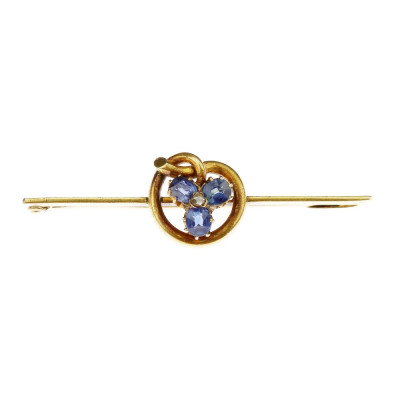

Sapphire - not only beautiful blue
Author: Martina Exnerová
Let us discuss some basic information and interesting facts about another gem from the "big three" of coloured gemstones, which are historically and financially the most valued.
Basic properties of sapphire
Sapphire belongs to the corundum group. Pure corundum is aluminum oxide; sapphire's various colours are given by impurities of iron, chromium, copper, or magnesium. On the Mohs scale of hardness, it ranks 9. Thus, it belongs to the group of very hard and durable gemstones, suitable for any frequently worn jewellery. Although sapphire is almost synonymous with a beautiful blue colour, it comes in many remarkable colour variants. Sapphires can be pink, orange, salmon pink-orange, purple, green, yellow, or gray-black. There are also clear colourless sapphires called leuco sapphires, which sometimes replace diamonds in jewellery.
Jewellery quality standard sapphires are currently found in many places worldwide, traditionally in Kashmir (in India and Pakistan), on Ceylon (Sri Lanka), and in Burma (Myanmar), especially in the Mogok area, famous for mining another gemstone from the corundum family – ruby. They are also found in Australia, Thailand, Laos, Canada, the USA (Montana), Tanzania, and Madagascar. For us, the inhabitants of the Czech basin, it is certainly interesting that sapphires were also mined in our region in the past, in the Jizera Meadow area near Sapphire Stream. Research shows that mining was surprisingly extensive and reached its peak in quantity and quality in the 16th century.
Historically and culturally, blue sapphire has been associated with nobility, truth, sincerity, and loyalty. In the Middle Ages, it symbolised Heaven or Jesus Christ and heavenly blessings and adorned many royal jewels and garments. Today, sapphire is considered the birthstone of September and a gemstone suitable as a gift for the 5th and 45th wedding anniversaries.

The most valuable sapphires
The most common natural blue sapphires range in colour from light and lighter fully blue "cornflower" sapphires, through the typically intensely deep blue "royal" sapphires, to dark blue stones that in certain angles of observation appear almost black. Also, fine rutile inclusions visible under a microscope are not a flaw, as they prove the stone's natural origin and gemologists call them silk.
At the traditional "sapphire peak" is undoubtedly the rare Kashmir sapphire, whose intensely saturated and velvety blue colour has become the standard for the most valuable sapphire blue. An interesting fact is that sapphires in beautiful purple to dark purple tones are found on the Pakistani side of the historic Kashmir region.
Attention is also drawn to the recently highly valued luxury gemstone known as the Padparadscha sapphire, characterised by its unusual pink-orange to orange-pink colour. Some experts say that Padparadscha colors should be called "salmon" or "sunset." The word Padparadscha itself comes from Sanskrit and refers to the beautiful colour of a lotus flower. Its original source is the island of Ceylon / Sri Lanka. Similarly coloured sapphires are found in Madagascar and East Africa, but strict gemologists consider only those from Sri Lanka to be true Padparadscha sapphires.

Special sapphires
Among sapphires, there are also colour-changing sapphires – stones that change colour under different lighting. Under daylight-equivalent light, the base colour of a typical colour-changing sapphire ranges from blue to violet. Under artificial light, it ranges from purple-violet to strongly reddish. Some very rare sapphires change colour from purplish-red-brown in artificial light to green in daylight. When gemstone experts evaluate colour-changing sapphires, they describe the colour change as weak, medium, or strong. The strength of the colour change in these stones is the most important quality factor affecting its value.
A very impressive and less common stone is the asterism sapphire. To highlight the star effect in the gemstone, this type of stone is cut into a cabochon (dome shape). Asterism is a special optical phenomenon where a bright six-pointed star appears on the surface of the stone, sometimes even doubled.
Like many other gemstones, sapphire is also produced synthetically, which isn't that interesting, but the use of clear synthetic sapphire in demanding windows of checkout scanners and windows of spacecraft certainly is. Its high durability, identical to that of natural sapphire, makes it suitable for use in such extreme conditions. And lovers of quality watches are certainly familiar with the durable sapphire crystal.
Famous sapphires
But let's return to jewellery. One of the most iconic sapphire jewels is undoubtedly the engagement ring of Lady Diana, which later became the engagement ring of Kate Middleton, the current Princess of Wales. It is adorned with an oval central blue Ceylon sapphire weighing 12 carats, surrounded by fourteen diamonds.
Approximately three years ago, a new record for the price per carat of a Kashmir sapphire was set. At Christie’s auction house, a ring with a magnificent Kashmir sapphire weighing 35.09 carats was sold for 7,357,999 US dollars.
One of the largest cut sapphires is the so-called Logan Sapphire weighing 422.99 carats, originating from Ceylon / Sri Lanka and exhibited at the National Museum of Natural History in Washington.
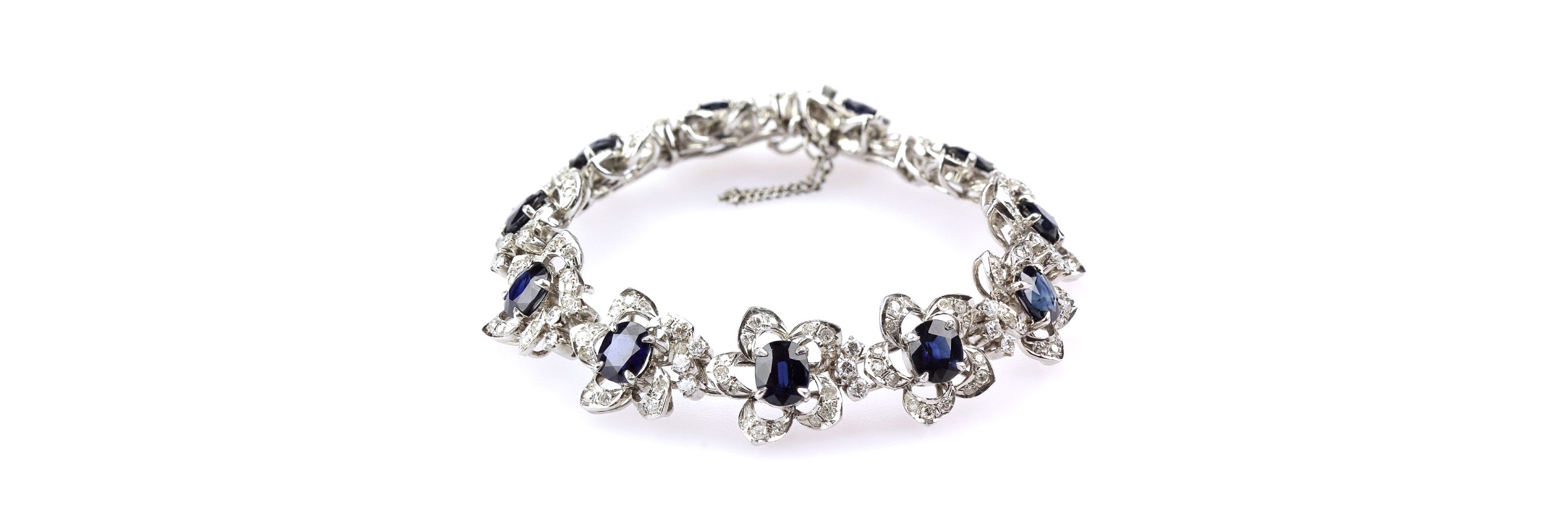
Traditionally, sapphires, in combination with diamonds or pearls, appear in royal jewellery sets, including a tiara, necklace, earrings, brooch, or pins, owned by almost all European royal and princely families. Among the most beautiful is the "Leuchtenberg Sapphire Parure," which today belongs to the Swedish Queen Silvia. The history of these jewels and their movement between families is fascinating. They were often wedding gifts or accompanied their family during sometimes dramatic relocations between states. And these century- and continent-traveling treasures are proof of the lasting value of precious gemstones.
Come visit us and take a look at and try on jewellery adorned with sapphires – and not just sapphires! – in our store on Maiselova Street. Perhaps one of our sapphires will catch your eye...
Related products
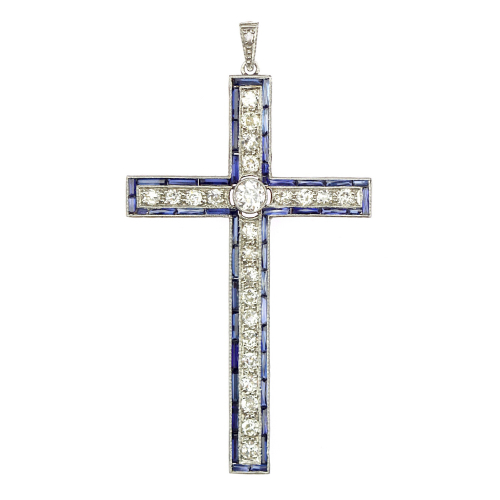
Art Deco cross with diamonds and sapphires
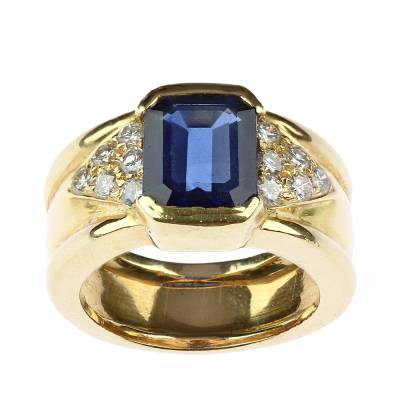
Ring with sapphire 3,40 ct and diamonds
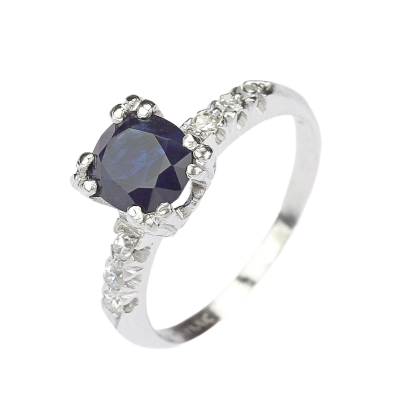
Platinum ring with sapphire - GIA CERTIFICATE
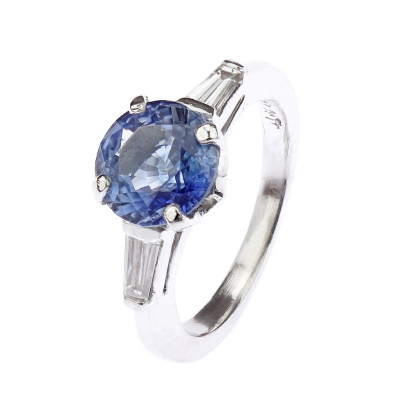
Platinum ring with sapphire 2,36 ct