
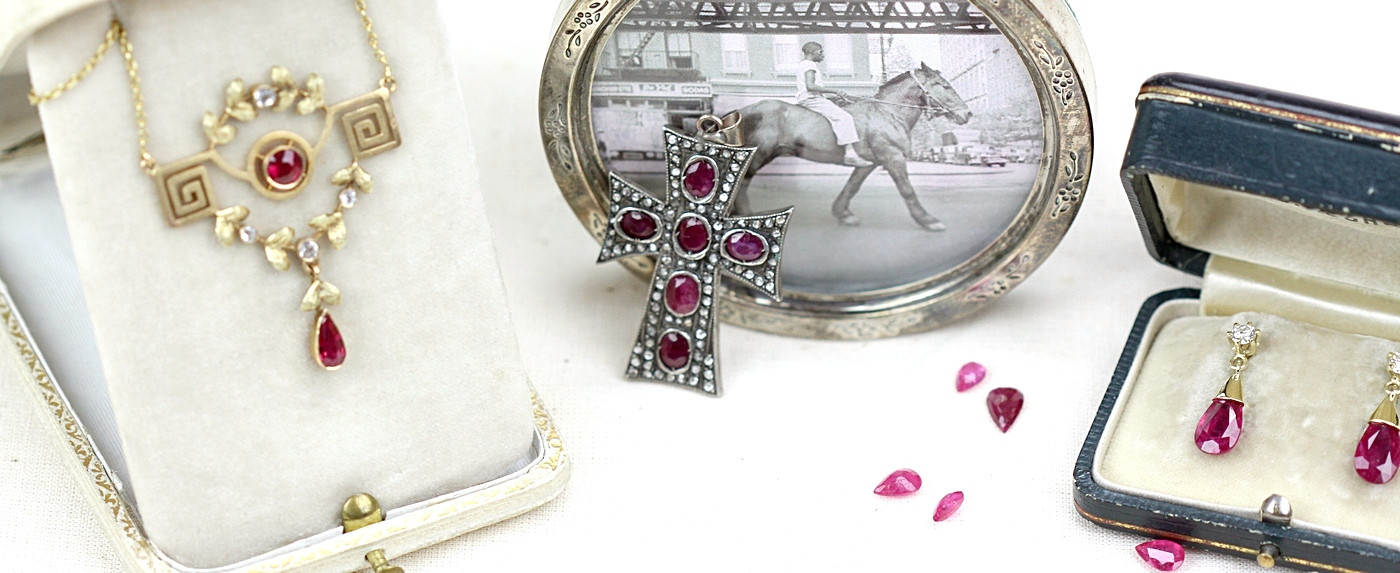
Natural or Synthetic Stones? Choose with both heart and reason
Author: Magdalena Kořínková
You may also have an antique piece of jewellery stored in a velvet box, adorned with a beautiful old-cut diamond. Surely, you have no doubt that this gem is indeed a precious stone. However, the truth might be different. With the naked eye, you may not distinguish between a natural stone and a synthetic one, or even between a gemstone and glass. Sometimes, identifying them can even be challenging for a professional. Let’s delve into the many secrets held by antique jewellery adorned with (supposedly) precious stones.
In that velvet box, you have a carefully kept jewel that your grandmother received from her grandmother. You are captivated by the beautiful antique craftsmanship and the old-cut stone. Curious about its value, you take it to a specialist. You have an idea of its price, which surely isn’t small – after all, it’s a truly old piece! But imagine your disappointment when the expert tells you that the stone isn’t a gemstone at all, but just plain glass...
When “Glass” Adorns the Jewel
This situation is not unusual. In the past, our ancestors often had to part with significant assets. How to handle this financially while maintaining appearances? One solution was to remove the precious stone and sell it. The jewellery was then "adorned" with glass. It still looked nice and valuable, and the glass "gem" was not easily distinguishable from a real one at first glance. But the value of the jewel became minimal. And since this step was often kept quiet, jewellery adorned with glass was passed down generations as highly valuable antiques…

Tricks as Old as Humankind
Glass was not the only substitute used to adorn jewellery in place of precious stones. Glass was fragile and vulnerable, easily breaking or scratching. Early attempts at creating synthetic stones began as early as the first half of the 19th century. In 1837, the French chemist Marc Antoine Gaudin produced an artificial ruby. Much later, in 1891, another French chemist, Auguste Victor Louis Verneuil, perfected the synthesis process. The method was published in 1902, and the first synthetic sapphire was officially patented in 1911. This means that many synthetic stones circulating today can be quite old as well.
TIP
Do you have such a jewel at home? We can help restore its original sparkle. We have an impressive selection of beautiful gemstones, including very old cuts.
Natural vs Synthetic – What’s the Difference?
Natural stones were mined from the earth, formed purely through natural processes and long, complex geological transformations. This is what makes them truly unique and highly valuable. If you were to see a freshly mined gemstone, you might not even recognise it. It must be refined. Nothing is more stunning than when a rough gemstone is cut into a sparkling jewel.
Synthetic stones are practically indistinguishable from natural ones chemically, optically, and physically – including hardness and refractive index. The difference is that they were manufactured, either using the Verneuil method (crystallisation) or the Czochralski method, involving dissolution or other lab techniques.
Putting Ecology First – Or Not?
These synthetic stones often lack flaws, except for one – they are artificial. However, many people don’t mind – they look beautiful, have the same chemical and physical qualities as natural stones, cost significantly less, and unlike mining, don’t harm the environment. If you are drawn to synthetic stones for ecological reasons, think twice. The carbon footprint of producing a 1-carat synthetic diamond in China using the CVD method is 40% higher than that of a natural diamond. This is due to the immense energy demand, mostly generated by fossil fuels.

The Mysteries of LGD, CVD, and HPHT
These acronyms stand for synthetic diamond manufacturing methods. LGD are lab-grown diamonds, produced over two to three weeks. Currently, there are two LGD production methods: HPHT (High Pressure, High Temperature) and CVD (Chemical Vapor Deposition).
When Age and Origin Matter
If laboratory-created stones are so flawless, how can one distinguish them from natural stones? Sometimes, this can be a real challenge – take, for instance, the stunning Kashmiri sapphire in our National Museum, valued at 19 carats and worth millions of crowns. Imagine the surprise when it was discovered to be a lab-grown creation rather than a natural gem...
It is the manufacturing process itself that leaves traces, which can be detected using specialised instruments.
However, these instruments are quite rare – there are only a handful of them in the Czech Republic. We’re delighted to announce that soon, Antiques Cinolter will be one of the proud owners of this technology. With it, we’ll be able to identify a stone’s origin within seconds.
Artificial vs. Natural Stones from an Investment Perspective
If you’re acquiring precious stones not only for their beauty but also as an investment, lab-created gems likely won’t be what you store in your safe. They simply cannot replace the economic value of natural stones. Natural stones never lose value; they appreciate over time, making them valuable long-term investments. In contrast, the value of laboratory-grown stones has fallen by as much as 60% in recent years.
A reputable dealer will always inform you about the stone's nature, and if you have any doubts, it’s wise to get its value verified. We are pleased to soon be able to provide this verification service at Antiques Cinolter.
Related product

Gold friendship brooch
Price: 12,500 Kč
It is an opening medallion with an inserted hand (clenched palm should...
