

Czech jewellers at the turn of 19th and 20th century
Author: Magdalena Kořínková
The turn of the 19th and 20th centuries was a period when the artisanal goldsmiths began to bring in artistic touches from other disciplines. Not only goldsmiths and jewellers, but also architects, glassmakers, painters, sculptors and stage designers began to influence the appearance of jewellery. The use of various materials and technologies also changed - jewellery was transformed from an ornament or utilitarian object into an individual work of art that proudly bore the name of its jeweller.
Fresh wind from France
At the beginning of the 20th century, in the period when Art Nouveau, ruled the art world, the Czech jewellery industry was mainly influenced by the School of Applied Arts in Prague. The teachers Celda Klouček and Emanuel Novák, whose great role model was the important French Art Nouveau jeweller, glassmaker and designer René Lalique, played an important role in this.
Like-minded artists met in artistic associations. Very important in this field was the Artěl group (founded in 1908), whose Ten Commandments on Modern Jewellery became an inspiration for post-war jewellery design. Important members of Artěl were jewellers Rudolf Stockar, František Kysela, Vratislav H. Brunner and sculptor, medallist, jeweller and designer Jaroslav Horejc.
Czech jewellery of the 19th and 20th centuries is also associated with other important names such as František Anýž, Josef Ladislav Němec and the unmistakable Marie Křivánková. In this blog we will bring you their small medallions.

František Anýž (1876-1934)
A trained modeller, moulder and ironworker, was so talented that he was recommended to study at the School of Arts and Crafts in Prague. He graduated from the school in 1899 and then undertook a study tour of Germany and Paris, where he visited the World Exhibition and became acquainted with the work of the famous jewellery makers Lalique and Fabergé.
His life continued to revolve around metals - he founded a factory for casting and hammering metal objects, built a hall with a foundry, and a stamping plant for medals, plaques and badges. After 1918 he began to devote himself to sculpture and the creation of decorative objects, his stylish jewellery was often decorated with Bohemian garnets.
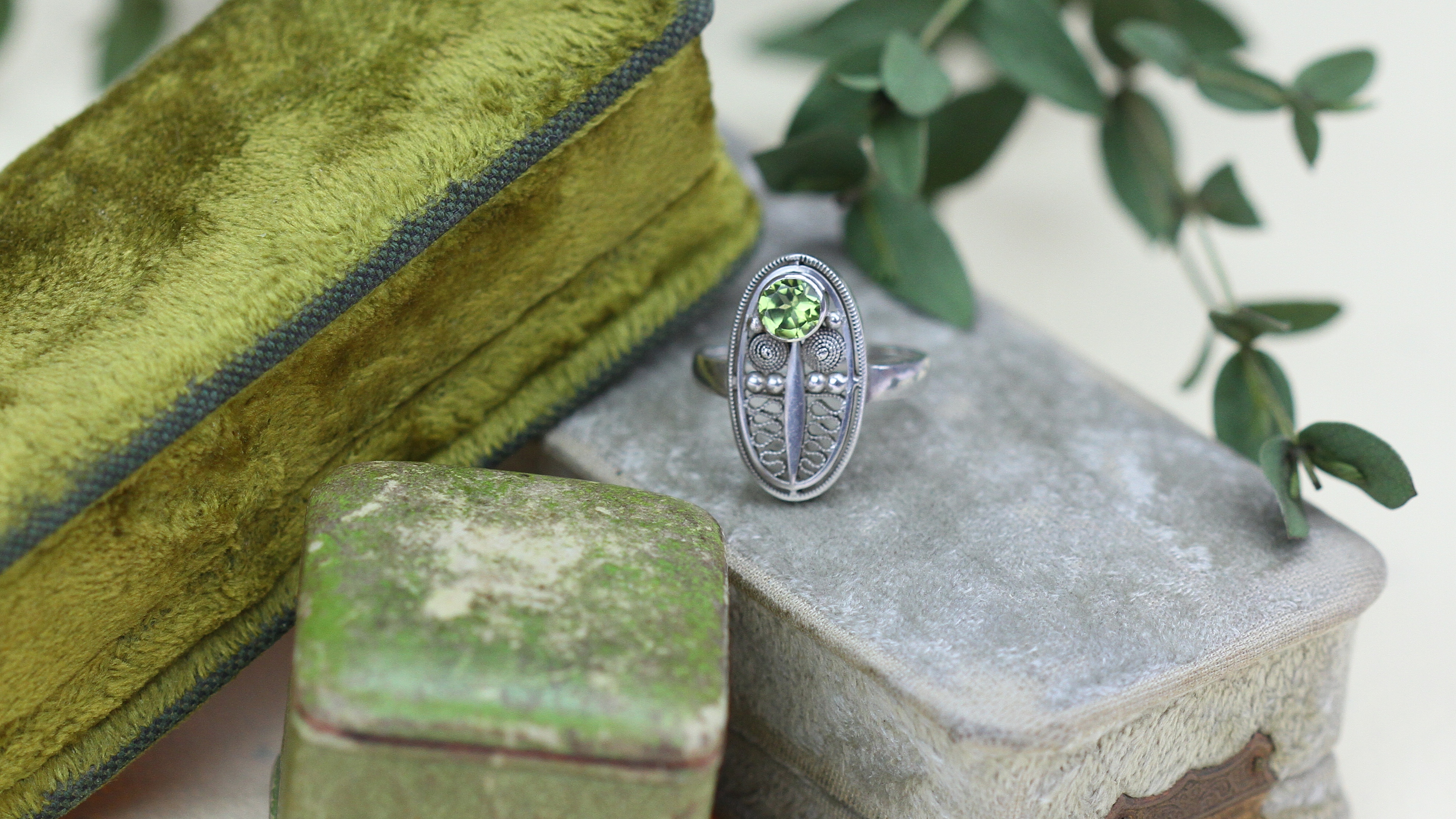
Josef Ladislav Němec (1871-1943)
Josef Ladislav Němec came from the family of the goldsmith and silversmith of Václav Němec, who significantly contributed to the establishment of the Vocational Continuation School for goldsmiths. From 1971 he also had his own goldsmith and silversmith workshop, and as a member of the Prague Chamber of Commerce he exhibited his jewellery. As he was also involved in politics, it was his son Josef Ladislav Němec who helped him with the workshop. He expanded the knowledge from his father's workshop by studying in Paris, where he learned, among other things, the technique of enamel. During his study trip, he also visited London, Dresden, Brussels and Antwerp, and thanks to the experience he gained, he became the director of the Continuation School for goldsmiths and related crafts upon his return to Prague.
The workshop Němec, father and son, contributed to the creation of a strong Art Nouveau current in Czech jewellery making. Josef Ladislav Němec is undoubtedly one of the most important Czech Art Nouveau goldsmiths.
Marie Křivánková (1883-1936)
Studied at the Continuation School for goldsmiths, silversmiths and related crafts. After her studies, she first became a clerk and then a jewellery designer in the Prague goldsmith Max Schober's firm, inspired by the late Art Nouveau jewellery of the Wiener Werkstätte.
A characteristic feature of her jewellery is the spiral, volute, helix and meander made with filigree or granulation. She also liked to use a chain which, thanks to the sagging, formed trimmings on the ends often decorated with stones. She was fond of using distinctive central stones, whether emeralds, onyxes, gems or synthetic rubies. She also fashioned cut coloured glass into silver jewellery.
She was so successful in her field and her work so distinctive and sought after that she became independent and ran her own jewellery and antique shop on Wenceslas Square in Prague. Her designs were used by Roman Jankovský, František Hladík, Pavel Vávra and František Javůrek. At the beginning of the 20th century, it was the latter who made a distinctive oval brooch made of yellow 14k gold and large jasper according to Marie Křivánková's design, which was until recently on offer at Antiques Cinolter and now has its own owner.

Traces of ancient times
Every time you pick up an antique piece of jewellery, imagine the artist behind its creation. How much time he or she spent preparing the design, figuring out every detail, and then finely working and decorating it.
Even after many years, antique jewellery carries a deep historical and artistic trace that you won't find in many modern, machine-made jewels. Come to Antiques Cinolter to choose antique jewelry and add unique pieces to your jewelry box.
Related product
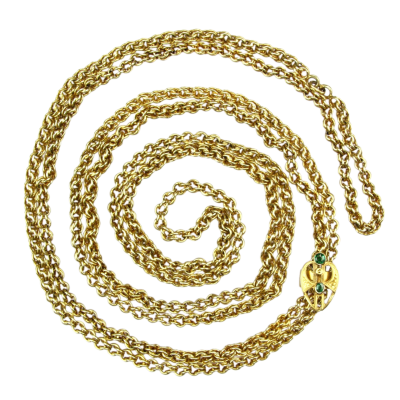
Long gold chain with slider - Art Noveau
Price: 75,000 Kč
Long (pocket watch) chain made of yellow 14k gold. The moving slider on the...
